Never get statement-shocked
again.
That little jolt when the statement arrives bigger than you expected? It comes from not looking for three weeks. Runtab ends it: your live credit-card balance — posted and pending — sits in your Mac menu bar all day. No budgets to maintain. No categories to sort. No app to remember to open. Just the number, always.

If you recognize any of this, keep reading.
- You know roughly what you spend every month. You just don't track it day-to-day.
- You only log into your bank when something forces you to — statement day, travel, a suspicious charge.
- Every month the statement lands a little higher than you expected — that small stomach-drop on statement day, then you pay it and move on.
- You've tried YNAB, Monarch, maybe Mint back in the day. They demanded a ritual you didn't have time for, so you quit.
- You occasionally wonder if your bank's numbers are subtly wrong — but proving it would mean reconciling statements by hand. Nobody has time for that.
This app was built for that specific person. Me.
Three things it does differently.
Always visible. Never in an app.
The balance sits in the Mac menu bar next to your clock. No login, no dashboard, no daily decision to check. You see it whenever you glance up — which turns out to be exactly when you can still do something about it.
Receipts against your bank.
Every day Runtab saves an immutable snapshot of what your bank said you owed. Those records never change. If a balance moves in a direction you can't explain, you compare today's numbers to a snapshot from 17 days ago and see exactly what shifted.
A running total you can actually trust.
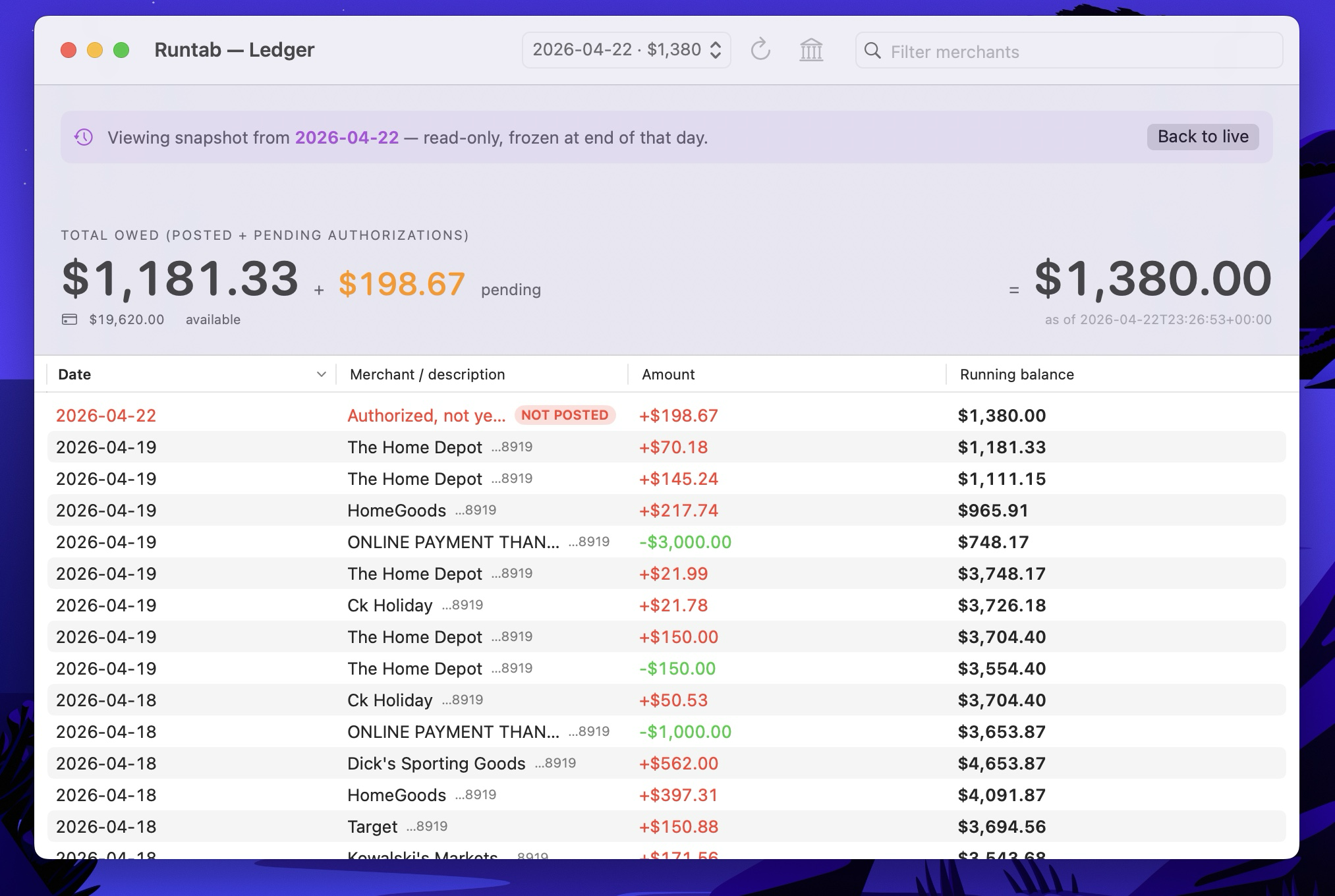
Every transaction adds up to the balance, one line at a time. No hidden rounding, no "posted vs. pending" fog. If the math doesn't line up, the gap is shown explicitly as its own row in the ledger.
This is what always visible looks like.
Click the number and you get the breakdown. No more, no less.
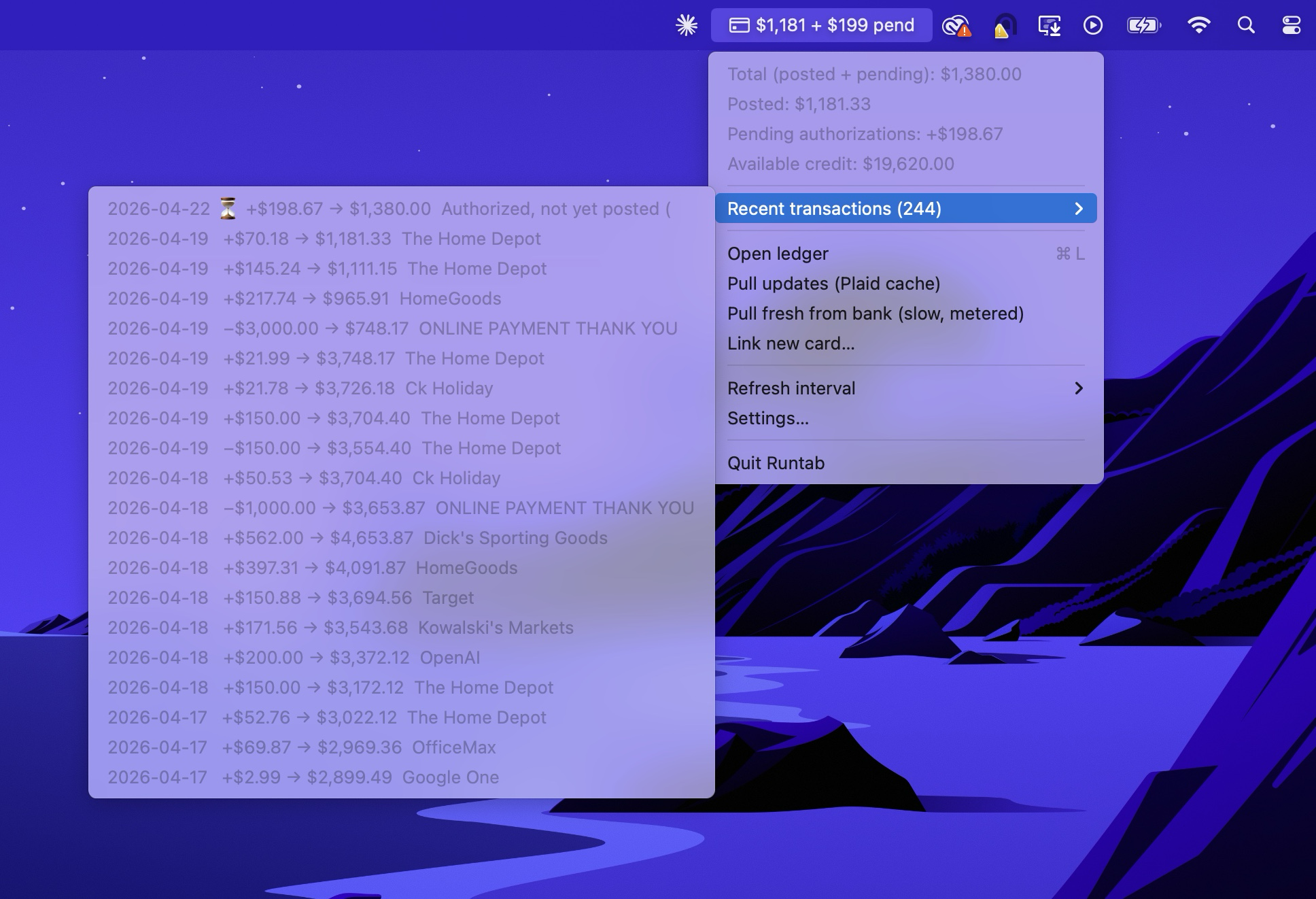
The full ledger is a ⌘⇧R away.
When you actually want to sit with the numbers, press ⌘⇧R from any app and the native ledger window comes forward. Every transaction in chronological order, the running balance after each one, badges for pending and not-yet-posted holds.
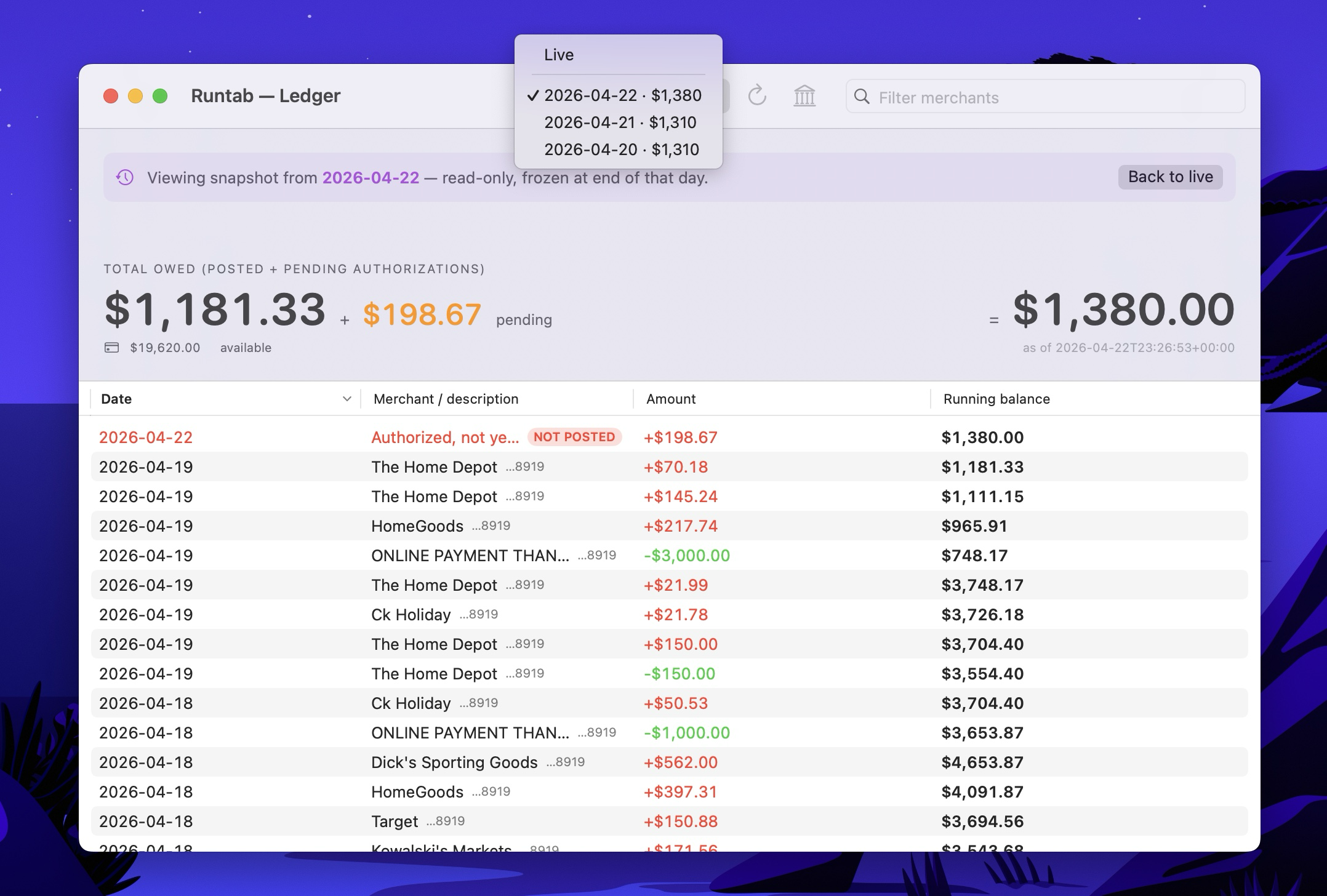
And every day becomes a receipt.
Runtab snapshots your balance at the end of every UTC day and freezes it. Past days can't be silently overwritten — by your bank, by Plaid, or by Runtab itself. If you ever need to prove what the balance was on the 19th, you just pick the 19th.
Connecting a credit card requires trust. Here's exactly what that connection can and can't do.
Read-only. There is no write path.
Runtab's Plaid connection can read balances and transactions — that's the entire permission. It cannot move money, make payments, open accounts, or change anything at your bank. Not "we promise not to" — the connection type doesn't support it.
Your bank login never touches Runtab.
You sign in through Plaid — usually on your bank's own website — the same connection rails Venmo and Robinhood use. Your credentials go to your bank, never to us. Plaid protects data in transit and at rest with TLS and AES-256 encryption.
We never have your card number.
Plaid shares only the last four digits with Runtab. Full card numbers never reach our systems — we can't leak what we never receive. Same for payments: your subscription card is handled entirely by Stripe.
What we do store, plainly.
Your balances and transaction history — they power the number in your menu bar, the ledger, and the daily snapshots. They live on private, self-hosted infrastructure, visible only to your account. Never sold, never shared, no analytics vendors, no ads.
Leave completely, any time.
Unlink in the app, revoke Runtab's access yourself at my.plaid.com or in your bank's security settings, and email support@runtab.io for full deletion. Lapsed trials are disconnected from Plaid automatically.
The fine print, in plain language: privacy policy.
Price
$5/month or $48/year. 14-day free trial, cancel anytime. Mac-only. Requires macOS 14 or later on Apple silicon.
No ads, no upsells, no free tier with locked features. One person built this, one person maintains it, and it charges for itself to stay that way.
A note from the person who built this.
I build software for a living. For most of my career I've had a specific rhythm with credit cards: spend reflexively, ignore the statements, pay the balance off in one chunk when something forces me to look. Not a crisis — just not optimal. It was taking mental bandwidth I wanted back for actual work.
I tried the big personal-finance apps. They want a daily or weekly ritual — categorize these transactions, adjust these envelopes, reconcile these accounts. I don't have that ritual in me. I have engineering deadlines.
So I built Runtab to stop thinking about my credit card while still knowing what I owed. The number lives at the top of my screen whether I want it to or not. I'm not surprised anymore.
— Dean
Not ready to install?
The app is free to try for 14 days — but if you're on a work machine or just browsing, drop your email and I'll send you the download link plus an occasional update. No spam, one-click unsubscribe.
Frequent questions
- Why not free?
- Your data lives on real infrastructure that costs money, and connecting to your bank via Plaid costs money per month. This is a one-person operation with no ads, no data sharing, and no VCs — the subscription is what keeps it that way.
- Why Mac-only?
- An always-visible menu bar is the entire product. Phones and Windows don't have the same ambient surface. The form factor is the value — adding platforms would dilute it.
- Can I self-host this?
- Not right now. Plaid's per-user approval process makes that impractical for anyone who isn't a developer. If that changes, I'll revisit.
- What if my bank's data is wrong on a given day?
- You'll see the discrepancy in the ledger and have a tamper-proof snapshot of what the bank said the day before. That's most of the point.
- What happens when my bank's OAuth session expires?
- You get a "reconnect" banner in the menu bar. One click, 30 seconds of credentials, you're back. Runtab also detects when your bank is having a service outage and surfaces that instead of silently showing stale numbers.
- Who is this for?
- One person, one credit card. Someone who earns more than they track and wants to keep it that way without ending up surprised. I'll build for other shapes (multiple cards, couples, business accounts) later if the first version lands.